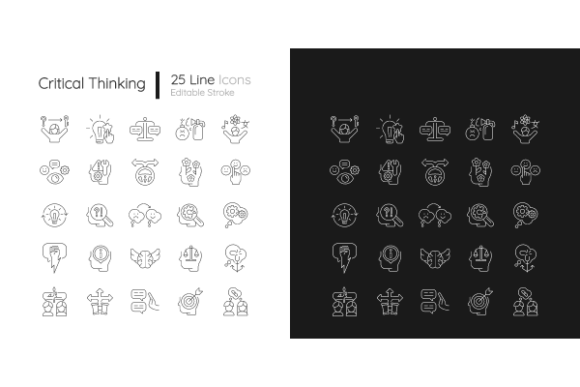
Critical Thinking RGB Icons: An Embroidery Review
As a professional embroidery designer and product reviewer, I approach every new graphic asset with a specific question: will this actually stitch out cleanly on fabric? Vector graphics are beautiful on screen, but the transition from digital pixels to physical thread is where many designs fail. After evaluating the Critical Thinking RGB Color Icons Bundle, I have some practical insights for fellow makers, Etsy sellers, and apparel decorators considering this collection for their next project.
This bundle focuses on intellectual and logical skills, featuring themes like evaluation, observation, and communication. The aesthetic is clean, modern, and intentionally simple. For those of us in the custom apparel or educational merchandise space, finding machine embroidery design assets that represent cognitive concepts without looking cluttered is a genuine challenge. These isolated vector illustrations offer a promising starting point, but their success depends entirely on how you adapt them for the needle.
First Impressions: Visual Clarity Meets Stitch Reality
My first impression of the Critical Thinking RGB Color Icons Bundle is that it respects the limitations of thread. The "simple filled line drawings" description is accurate and, frankly, a relief. In embroidery, complexity is often the enemy of clarity, especially at smaller sizes. These icons avoid intricate gradients or microscopic details that would turn into a thread nest on your hoop.
The mood is professional yet accessible. Because they are designed as RGB color icons, they possess a vibrancy that translates well to polyester and rayon thread colors. However, as any experienced digitizer knows, RGB values on a monitor do not perfectly match physical thread charts. The visual personality here is academic and structured, making these graphics ideal for tutoring centers, debate teams, corporate training merch, or personalized gifts for graduates and educators. They feel intentional rather than decorative, which adds perceived value to any finished product.
Real-World Application: Stitching a Tutor’s Tote Bag
To truly test the viability of this bundle, I mentally walked through a recent client request: a custom embroidered tote bag for an academic coaching business. The client wanted symbols representing "observation" and "evaluation" placed near the bottom corner of a canvas tote.
Using these graphics as a base for the embroidery file worked exceptionally well because of their isolation. There is no unnecessary background noise. When converting these vectors into a machine embroidery design, the simple shapes allowed for efficient stitch paths. I could utilize a combination of satin stitch for the bold outlines and light fill stitch for the interior color blocks. This balance keeps the stitch density manageable, preventing the canvas fabric from puckering or becoming too stiff.
For this specific handmade product, the icons communicated professionalism instantly. Unlike generic clip art, these designs looked bespoke. If you are an Etsy seller creating niche academic gear, this level of thematic specificity helps build customer trust. Buyers recognize when a design has been chosen with intention. The resulting tote bag wasn't just a bag; it was a branding tool that clearly articulated the business's focus on critical thinking skills.
Navigating Fabric Textures and Hoop Constraints
While the Critical Thinking RGB Color Icons Bundle is versatile, it is not immune to the laws of physics. You must be strategic about where you place these designs. The "simple filled line" style relies on crisp edges. If you attempt to stitch these on high-pile terry cloth or thick fleece without proper preparation, the lines will get lost in the fabric texture.
I recommend using these icons primarily on stable, smooth-weave fabrics. Cotton twill, denim, canvas, and poplin are excellent choices for sweatshirt embroidery or apron projects. If you must use them on stretchy knits or textured materials, you need to adjust your stabilizer strategy significantly. A heavy cut-away stabilizer and potentially a water-soluble topping are non-negotiable to maintain the integrity of the geometric shapes.
Be cautious with small hoop sizes. While the icons are simple, reducing them below two inches can cause issues if the original vector lines are too thick relative to the scaled-down size. Always check your stitch density after resizing. If the satin stitches become too narrow, they may disappear; if they remain too wide for the small scale, they will look clumsy. Test on scrap fabric first. This step saves time, thread, and frustration, ensuring your commercial embroidery output remains consistent.
Commercial Value and Brand Consistency
For creative entrepreneurs and small shop owners, consistency is currency. One of the strongest selling points of this bundle is its cohesive visual language. When you are building a product line—perhaps a series of teacher appreciation mugs, student mentor patches, or library volunteer shirts—having a unified set of graphics ensures your brand looks polished.
These icons also serve double duty for digital product sellers. Before you even thread your machine, you can use the vector files to create printable mockups for your listings. High-quality previews drive buyer engagement. When customers see a clean, professional digital preview that accurately reflects the eventual embroidered patch or custom apparel, conversion rates improve. Just remember to verify the licensing terms included with the bundle before selling finished items or distributing digital embroidery file derivatives. Protecting your business means respecting intellectual property.
Essential Designer Notes for Success
If you decide to incorporate the Critical Thinking RGB Color Icons Bundle into your workflow, keep these practical tips in mind to ensure the best results:
- Thread Color Matching: Since these are RGB source files, do not rely on auto-digitizing software to pick your thread colors. Manually select thread colors that match the intended vibrancy. Test contrast against both light and dark fabric backgrounds, as RGB brightness can be deceptive.
- Stitch Type Selection: Avoid converting entire icons to dense fill stitch. Use running stitch or split stitch for internal details to reduce bulk. Reserve satin stitch for borders and key focal points only.
- Size Verification: Confirm the minimum viable size for each icon. Some logical symbols contain negative space that may close up if stitched smaller than 1.5 inches. Always run a sew-out test on the actual fabric you intend to use.
- Stabilizer Pairing: Match your stabilizer to the fabric weight, not just the design size. Even a simple icon can distort lightweight cotton if under-stabilized. For baby embroidery or delicate garments, consider using a soft mesh cut-away to prevent skin irritation while maintaining shape.
- Licensing Check: Before listing any personalized gift or boutique product for sale, review the specific license provided with this bundle. Ensure you are cleared for commercial embroidery use versus personal crafting only.
Final Verdict for Makers
The Critical Thinking RGB Color Icons Bundle is a valuable asset for the right niche. It bridges the gap between abstract intellectual concepts and tangible handmade products. Its strength lies in its simplicity, which makes it forgiving for intermediate digitizers and efficient for production shops. Whether you are stitching a holiday gift for a philosophy professor or creating branded merchandise for a coding bootcamp, these graphics provide a solid foundation.
Success with this bundle comes down to respecting the medium. Treat the vectors as a blueprint, not a final command. Adapt the stitch density, choose your fabrics wisely, and test rigorously. When executed with care, these icons elevate your work from generic decoration to thoughtful, communicative design. For the embroiderer willing to put in the technical prep work, this collection offers a distinct edge in a market saturated with overly complex, poorly digitized alternatives.